


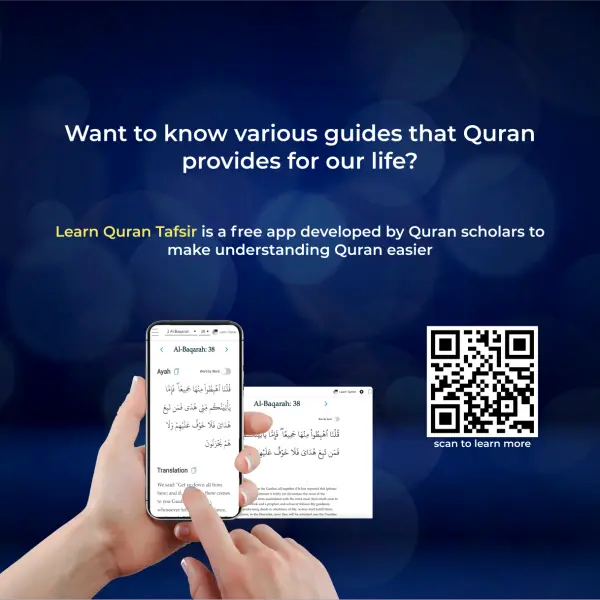


Join over 4 million Quran learners from more than 180 countries
Ayah
Word by Word
وَمَا
And not
خَلَقۡنَا
We created
ٱلسَّمَآءَ
the heaven
وَٱلۡأَرۡضَ
and the earth
وَمَا
and whatever
بَيۡنَهُمَا
(is) between them
بَٰطِلٗاۚ
without purpose
ذَٰلِكَ
That
ظَنُّ
(is the) assumption
ٱلَّذِينَ
(of) those who
كَفَرُواْۚ
disbelieve
فَوَيۡلٞ
So woe
لِّلَّذِينَ
to those
كَفَرُواْ
who disbelieve
مِنَ
from
ٱلنَّارِ
the Fire
وَمَا
And not
خَلَقۡنَا
We created
ٱلسَّمَآءَ
the heaven
وَٱلۡأَرۡضَ
and the earth
وَمَا
and whatever
بَيۡنَهُمَا
(is) between them
بَٰطِلٗاۚ
without purpose
ذَٰلِكَ
That
ظَنُّ
(is the) assumption
ٱلَّذِينَ
(of) those who
كَفَرُواْۚ
disbelieve
فَوَيۡلٞ
So woe
لِّلَّذِينَ
to those
كَفَرُواْ
who disbelieve
مِنَ
from
ٱلنَّارِ
the Fire
Translation
And We did not create the heaven and the earth and that between them aimlessly. That is the assumption of those who disbelieve, so woe to those who disbelieve from the Fire.
Tafsir
And We did not create the skies and the earth and all that is between them in vain, frivolously. That, namely, the creation of what has been mentioned as being for no [particular] purpose, is the supposition of those who disbelieve, from among the people of Mecca. So woe - a valley [in hell-fire] - to the disbelievers from the Hellfire!
The Wisdom behind the Creation of This World
Allah tells us that He did not create the creatures in vain; He created them to worship Him Alone, then He will gather them on the Day of Gathering and will reward the obedient and punish the disbelievers.
Allah says:
وَمَا خَلَقْنَا السَّمَاء وَالاَْرْضَ وَمَا بَيْنَهُمَا بَاطِلً ذَلِكَ ظَنُّ الَّذِينَ كَفَرُوا
And We created not the heaven and the earth and all that is between them without purpose! That is the consideration of those who disbelieve!
meaning, those who do not think that the resurrection and the place of return will occur, but they think that there is nothing after this world.
فَوَيْلٌ لِّلَّذِينَ كَفَرُوا مِنَ النَّارِ
Then woe to those who disbelieve from the Fire!
means, woe to them on the Day when they will be resurrected, from the Fire that is prepared for them.
Then Allah explains that because of His justice and wisdom, He does not treat the believers and the disbelievers equally.
Allah says:
أَمْ نَجْعَلُ الَّذِينَ امَنُوا وَعَمِلُوا الصَّالِحَاتِ كَالْمُفْسِدِينَ فِي الاَْرْضِ أَمْ نَجْعَلُ الْمُتَّقِينَ كَالْفُجَّارِ
Shall We treat those who believe and do righteous good deeds as those who do mischief on the earth? Or shall We treat Those who have Taqwa as the evildoers?
meaning, `We shall not do that.'
They are not equal before Allah, and since this is the case, there must inevitably be another realm in which those who obey Allah will be rewarded and the wicked will be punished. This teaching indicates to those of a sound mind and upright nature that there must inevitably be a resurrection and recompense.
We see evildoers and criminals are prospering and increasing in wealth, children and luxury, until they die in that state. We see oppressed believers dying of grief and distress, so by the wisdom of the All-Wise, All-Knowing, All-Just who does not do even a speck of dust's weight of injustice, there should be a time when the rights of the oppressed are restored with due justice. If this does not happen in this world, there must be another realm where recompense may be made and consolation may be found.
The Qur'an teaches sound aims based on a rational way of thinking, so Allah says:
كِتَابٌ أَنزَلْنَاهُ إِلَيْكَ مُبَارَكٌ لِّيَدَّبَّرُوا ايَاتِهِ وَلِيَتَذَكَّرَ أُوْلُوا الاَْلْبَابِ
(This is) a Book which We have sent down to you, full of blessings, that they may ponder over its Ayat, and that men of understanding may remember.
meaning, those who are possessed of wisdom and reason
Suleiman the Son of Dawud
Allah tells,
وَوَهَبْنَا لِدَاوُودَ سُلَيْمَانَ
And to Dawud We gave Suleiman. How excellent a servant! Verily, he was ever turning in repentance (to Us)!
Allah tells us that he gave Suleiman to Dawud as a Prophet, as He says elsewhere:
وَوَرِثَ سُلَيْمَـنُ دَاوُودَ
And Suleiman inherited Dawud, (27:1)
meaning, he inherited Prophethood from him. Dawud had other sons besides Suleiman, for he had one hundred free wives.
نِعْمَ الْعَبْدُ إِنَّهُ أَوَّابٌ
How excellent a servant! Verily, he was ever oft-returning in repentance (to Us)!
This is praise for Suleiman, because he was very much obedient, worshipping Allah much and always turning to Allah in repentance.
إِذْ عُرِضَ عَلَيْهِ بِالْعَشِيِّ الصَّافِنَاتُ الْجِيَادُ
When there were displayed before him, in the afternoon, well trained horses of the highest breed.
means, these well trained horses were shown to Suleiman, peace be upon him, in his capacity as king and ruler.
Mujahid said,
They were the kind of horses which stand on three legs and raise the fourth, and they were swift horses.
This was also the view of several others among the Salaf.
Abu Dawud recorded that A'ishah, may Allah be pleased with her, said,
The Messenger of Allah came back from the campaign of Tabuk or Khyber, and there was a curtain covering her room. The wind came and lifted the curtain, revealing some toys belonging to A'ishah, may Allah be pleased with her.
The Prophet said:What is this, O `A'ishah?
She, may Allah be pleased with her, said, My toys.
Among them he ﷺ a horse with two wings made of cloth. He said:
مَا هَذَا الَّذِي أَرَى وَسَطَهُنَّ
What is this that I see in the midst of them?
She, may Allah be pleased with her, said, A horse.
The Messenger of Allah said,
مَا هَذَا الَّذِي عَلَيْهِ
And what is this on it?
She, may Allah be pleased with her, said, Wings.
The Messenger of Allah said,
فَرَسٌ لَهُ جَنَاحَانِ
A horse with two wings?
She, may Allah be pleased with her, said, Did you not hear that Suleiman, peace be upon him, had a horse that had wings
She, may Allah be pleased with her, said, The Messenger of Allah smiled so broadly that I could see his molars.
And Allah tells further that,
فَقَالَ إِنِّي أَحْبَبْتُ حُبَّ الْخَيْرِ عَن ذِكْرِ رَبِّي حَتَّى تَوَارَتْ بِالْحِجَابِ
He said:I did love the good (i.e., horses) instead of remembering my Lord, till the time was over, and (the sun) had hidden in the veil (of night).
More than one of the Salaf and scholars of Tafsir mentioned that he was so busy looking at the horses that he missed the time of `Asr prayer. He did not miss it deliberately, but because of forgetfulness, as happened to the Prophet on the day of Khandaq, when he was too busy to pray `Asr and he prayed it after the sun had set.
This was recorded in the Two Sahihs with more than one chain of narration, including the report from Jabir, may Allah be pleased with him, who said,
On the day of Khandaq, Umar, may Allah be pleased with him, came after the sun had set and started cursing the disbelievers of the Quraysh. He said, `O Messenger of Allah, I could not pray `Asr until the sun had almost set.'
The Messenger of Allah said,
وَاللهِ مَا صَلَّيْتُهَا
By Allah, I did not pray it either.
He (Jabir) said, So we got up and went to Buthan. Allah's Prophet performed ablution for the prayer and we too performed ablution. He prayed `Asr after the sun had set, then he prayed Maghrib after that.
And Allah tells further that,
رُدُّوهَا عَلَيَّ فَطَفِقَ مَسْحًا بِالسُّوقِ وَالاَْعْنَاقِ
Then he said:Bring them (horses) back to me. Then he began to pass his hand over their legs and their necks.
Al-Hasan Al-Basri said,
He said, `No, by Allah, you will not keep me from worshipping my Lord again,' then he ordered that they should be slaughtered.
This was also the view of Qatadah.
As-Suddi said,
Their necks and hamstrings were struck with swords.
Ali bin Abi Talhah reported that Ibn Abbas, may Allah be pleased with him, said,
He began patting the horses' heads and legs out of love for them.
This is the view that was favored by Ibn Jarir. He said,
Because he would not punish an animal by cutting its hamstrings or destroy his own wealth for no other reason than that he had been distracted from his prayer by looking at it, and it was not the animals' fault.
This view which Ibn Jarir thought more correct is subject to further review, because such action may have been permissible according to their law, especially since he got angry for the sake of Allah for being distracted by these horses until the time for prayer had lapsed. Then, since he dispensed with them for the sake of Allah, Allah compensated him with something better, the wind which blew gently by his order wherever he willed. Its morning lasted a month's (journey), and its afternoon lasted a month's (journey). This was faster and better than horses.
Imam Ahmad recorded that Abu Qatadah and Abu Ad-Dahma', who traveled a lot to the Ka`bah, said,
We met a man from among the Bedouins who said to us:`The Messenger of Allah took my hand and started teaching me some of that which Allah had taught him. He said,
إِنَّكَ لَا تَدَعُ شَيْيًا اتِّقَاءَ اللهِ تَعَالَى إِلاَّ أَعْطَاكَ اللهُ عَزَّ وَجَلَّ خَيْرًا مِنْه
You do not give up anything for the sake of Allah, but Allah will give you something better than it.
How Allah tested Sulayman then made Things easy for Him
Allah says,
وَلَقَدْ فَتَنَّا سُلَيْمَانَ
And indeed, We tried Suleiman,
meaning, `We tested him.'
وَأَلْقَيْنَا عَلَى كُرْسِيِّهِ جَسَدًا
and We placed on his throne Jasad (a body).
ثُمَّ أَنَابَ
and he returned.
means, after this test, he turned back to Him and asked for forgiveness and to be given a kingdom such as shall not belong to any other after him.
قَالَ رَبِّ اغْفِرْ لِي وَهَبْ لِي مُلْكًا لاَّ يَنبَغِي لاِاَحَدٍ مِّنْ بَعْدِي إِنَّكَ أَنتَ الْوَهَّابُ
He said:My Lord! Forgive me, and bestow upon me a kingdom such as shall not belong to any other after me. Verily, You are the Bestower.
Some of them said,
No one after me will have the right to ask Allah for such a kingdom.
This is the apparent meaning from the context of the Ayah, and several Hadiths with a similar meaning have been narrated from the Messenger of Allah.
In his Tafsir of this Ayah, Al-Bukhari recorded that Abu Hurayrah, may Allah be pleased with him, said that the Prophet said:
إِنَّ عِفْرِيتًا مِنَ الْجِنِّ تَفَلَّتَ عَلَيَّ الْبَارِحَةَ أَوْ كَلِمَةً نَحْوَهَا لِيَقْطَعَ عَلَيَّ الصَّلَةَ فَأَمْكَنَنِي اللهُ تَبَارَكَ وَتَعَالَى مِنْهُ وَأَرَدْتُ أَنْ أَرْبِطَهُ إِلَى سَارِيَةٍ مِنَ سَوَارِي الْمَسْجِدِ حَتْى تُصْبِحُوا وَتَنْظُرُوا إِلَيْهِ كُلُّكُمْ فَذَكَرْتُ قَوْلَ أَخِي سُلَيْمَانَ عَلَيْهِ الصَّلَةُ وَالسَّلَمُ
رَبِّ اغْفِرْ لِي وَهَبْ لِي مُلْكًا لاَّ يَنبَغِي لاَِحَدٍ مِّنْ بَعْدِي
An `Ifrit from among the Jinn came and bothered me last night- or he said something similar -Trying to stop me from praying. Allah enabled me to overpower him, and I wanted to tie him to one of the pillars in the Masjid so that you could see him this morning. Then I remembered what my brother Suleiman said,
My Lord! Forgive me and bestow upon me a kingdom such as shall not belong to any other after me.
Rawh said, so he let him go, humiliated.
This was also recorded by Muslim and An-Nasa'i.
In his Sahih, Muslim recorded that Abu Ad-Darda', may Allah be pleased with him, said,
The Messenger of Allah stood up to pray and we heard him say,
أَعُوذُ بِاللهِ مِنْك
I seek refuge with Allah from you.
Then he said,
أَلْعَنُكَ بِلَعْنَةِ الله
I curse you with the curse of Allah.
three times, and he stretched out his hand as if he was reaching out to take something. When he finished his prayer, we said, `O Messenger of Allah, we heard you say something in your prayer which we have never heard you say before, and we ﷺ you stretching out your hand.'
He said:
إِنَّ عَدُوَّ اللهِ إِبْلِيسَ جَاءَ بِشِهَابٍ مِنْ نَارٍ لِيَجْعَلَهُ فِي وَجْهِي فَقُلْتُ أَعُوذُ بِاللهِ مِنْكَ ثَلَثَ مَرَّاتٍ ثُمَّ قُلْتُ أَلْعَنُكَ بِلَعْنَةِ اللهِ التَّامَّةِ فَلَمْ يَتَأَخَّرْ ثَلَثَ مَرَّاتٍ ثُمَّ أَرَدْتُ أَنْ اخُذَهُ وَاللهِ لَوْلَا دَعْوَةُ أَخِينَا سُلَيْمَانَ لَاَصْبَحَ مُوثَقًا يَلْعَبُ بِهِ صِبْيَانُ أَهْلِ الْمَدِينَة
The enemy of Allah Iblis came with a flame of fire to throw in my face, so I said,
I seek refuge with Allah from you. three times,
then I said, I curse you with the complete curse of Allah, but he did not back off. I said it three times.
Then I wanted to seize him. By Allah, if it were not for the words of our brother Suleiman, he would have been chained up and he would have become a plaything for the children of the people of Al-Madinah.
Allah says:
فَسَخَّرْنَا لَهُ الرِّيحَ تَجْرِي بِأَمْرِهِ رُخَاء حَيْثُ أَصَابَ
So, We subjected to him the wind; it blew gently by his order wherever he willed.
Al-Hasan Al-Basri, may Allah have mercy on him, said,
When Suleiman, peace be upon him, slaughtered the horses out of anger for the sake of Allah, Allah compensated him with something better and swifter, the wind whose morning was a month's (journey), and its afternoon was a month's (journey).
حَيْثُ أَصَابَ
(wherever he willed). means, wherever in the world he wanted.
وَالشَّيَاطِينَ كُلَّ بَنَّاء وَغَوَّاصٍ
And also the Shayatin, from every kind of builder and diver,
means, among them were some whom he used to build high rooms, images, basins as large as reservoirs, and cauldrons fixed (in their places), and other difficult tasks which humans were unable to do. And there was another group, who dived into the sea recovering pearls, jewels and other precious things which cannot be found anywhere else.
وَاخَرِينَ مُقَرَّنِينَ فِي الاْاَصْفَادِ
And also others bound in fetters.
means, tied up in chains. These were the ones who had rebelled and refused to work, or else their work was bad and they were wrongdoers.
هَذَا عَطَاوُنَا فَامْنُنْ أَوْ أَمْسِكْ بِغَيْرِ حِسَابٍ
(Allah said to Suleiman):This is Our Gift, so spend you or withhold, no account will be asked of you.
means, `this that We have given to you of kingship and perfect power, as you asked for, you may give to whomsoever you wish and deny to whomsoever you wish, and you will not be brought to account. Whatever you do is permissible for you, so however you judge, it will be right.'
It was reported in the Two Sahihs that when the Messenger of Allah was given the choice between being a servant and a Messenger -- who does what he is commanded to do and distributes things among the people as Allah commands him to do -- or being a Prophet and a king, who can give to whomever he wishes and withhold from whomever he wishes without being held accountable for anything, he chose the former. He consulted with Jibril, peace be upon him, who said, Be humble. So he chose the former because it has a greater value before Allah and brings a higher status in the Hereafter, even though the second option, Prophethood combined with kingship, is also a great thing both in this world and in the Hereafter, when Allah tells us what He gave to Suleiman, peace be upon him, in this world, He tells us that he will have a great share with Allah on the Day of Resurrection.
He says:
وَإِنَّ لَهُ عِندَنَا لَزُلْفَى وَحُسْنَ مَأبٍ
And verily, for him is a near access to Us, and a good (final) return.
meaning, in this world and the Hereafter.
Not yet available. It requires resources to add this interpretation.
Not yet available. It requires resources to add this interpretation.
Not yet available. It requires resources to add this interpretation.
Not yet available. It requires resources to add this interpretation.
Not yet available. It requires resources to add this interpretation.
Not yet available. It requires resources to add this interpretation.
Not yet available. It requires resources to add this interpretation.
Commentary
The delicate order of the verses
These verses in which the basic beliefs of Islam, particularly that of the Hereafter, have been emphatically confirmed appear in between the description of events relating to Sayyidna Dawud (علیہ السلام) with an order that is extremely delicate and sublime. Says Imam Razi, if someone is refusing to understand because of obstinacy, the wiser approach is to put away the subject under discussion aside, and start talking about something totally unrelated - and when his mind stands diverted from the first subject, he should be brought around during the flow of conversation to concede to the original proposition. At this place, it is to dwell upon and secure confirmation of the Hereafter that this very method has been used. Being mentioned before the description of the event relating to Sayyidna Dawud (علیہ السلام) there were some postures of obstinacy demonstrated by the disbelievers that concluded at the verse: وَقَالُوا رَبَّنَا عَجِّل لَّنَا قِطَّنَا قَبْلَ يَوْمِ الْحِسَابِ (And they said, " 0 our Lord, give us our share [ of the punishment ] sooner, before the Day of Reckoning." - 38:16). The outcome of all this was to state that those people rejected the existence of the Hereafter and made fun of it. Immediately after that, it was said: اصْبِرْ عَلَىٰ مَا يَقُولُونَ وَاذْكُرْ عَبْدَنَا دَاوُودَ (Observe patience over what they say and remember Our servant, Dawud - 38:17). By saying so, a new subject was introduced. But, the event relating to Sayyidna Dawud (علیہ السلام) has been concluded with the statement:
O Dawud, We have made you a vicegerent on earth, so judge between people with truth. (38:26).
Now, from here it is in an imperceptible manner that the Hereafter has been positively confirmed by positing that here is the supreme Being of Allah asking his deputy on the earth to establish the rule of law and justice resulting in punishment for the evil and peace for the good - when so, is it not that the same Being would necessarily establish justice and equity in this universe? Most certainly, it is the dictate of His wisdom that He, rather than herd everyone good or bad with the same stick, punishes the doers of evil and rewards the doers of good. This, then, is the purpose of the creation of this universe, and in order that it translates into reality, it is necessary that there be a Qiyamah (the Last Day) and an 'Akhirah (the Hereafter) - something that precisely corresponds to His wisdom. Those who reject the Hereafter are virtually saying that this universe has been created aimlessly, devoid of any wisdom behind it, for everyone good or bad will live his or her time and die with nobody around to ask questions - although, one who has faith in the wisdom of Allah Ta’ ala can never accept this line of reasoning.
Not yet available. It requires resources to add this interpretation.
Tafsir Surat Sad: 27-29
Dan Kami tidak menciptakan langit dan bumi dan apa yang ada di antara keduanya tanpa hikmah. Yang demikian itu adalah anggapan orang-orang yang kafir, maka celakalah orang-orang kafir itu karena mereka akan masuk neraka. Patutkah Kami menganggap orang-orang yang beriman dan mengerjakan amal yang saleh sama dengan orang-orang yang berbuat kerusakan di muka bumi? Patutkah (pula) Kami menganggap orang-orang yang bertakwa sama dengan orang-orang yang berbuat maksiat? Ini adalah sebuah kitab yang Kami turunkan kepadamu penuh dengan berkah supaya mereka memperhatikan ayat-ayatnya dan supaya mendapat pelajaran orang-orang yang mempunyai pikiran.
Allah ﷻ menceritakan bahwa tidak sekali-kali Dia menciptakan makhluk-Nya dengan main-main, melainkan Dia ciptakan mereka supaya mereka menyembah-Nya dan mengesakan-Nya. Kemudian Allah akan menghimpun mereka di hari perhimpunan, maka Dia akan memberi pahala kepada orang yang taat dan mengazab orang yang kafir. Karena itulah, disebutkan oleh firman-Nya: Dan Kami tidak menciptakan langit dan bumi dan apa yang ada di antara keduanya secara sia-sia. Yang demikian itu adalah anggapan orang-orang kafir. (Shad: 27) Yakni orang-orang yang tidak percaya kepada hari berbangkit dan tidak pula kepada hari kembali, melainkan hanya percaya kepada kehidupan di dunia ini saja.
maka celakalah orang-orang kafir itu karena mereka akan masuk neraka. (Shad: 27) Maksudnya, celakalah mereka di hari mereka kembali saat mereka dibangkitkan karena akan memasuki neraka yang telah disediakan buat mereka. Kemudian Allah menjelaskan, bahwa termasuk keadilan dan hikmah-Nya Dia tidak menyamakan antara orang-orang mukmin dan orang-orang kafir. Untuk itu Allah ﷻ berfirman: Patutkah Kami menganggap orang-orang yang beriman dan mengerjakan amal yang saleh sama dengan orang-orang yang berbuat kerusakan di muka bumi? Patutkah (pula) Kami menganggap orang-orang yang bertakwa sama dengan orang-orang yang berbuat maksiat? (Shad: 28) Yakni Kami tidak akan melakukan hal seperti itu; mereka tidaklah sama di sisi Allah.
Dan apabila demikian, berarti pasti ada negeri lain yang di dalamnya orang yang taat diberi pahala dan orang yang durhaka mendapat siksaan. Petunjuk ini menuntut akal yang sehat dan fitrah yang lurus untuk menyimpulkan bahwa adanya hari akhirat dan hari pembalasan merupakan suatu kepastian. Karena sesungguhnya kita sering melihat orang yang zalim lagi melampaui batas makin bertambah harta, anak dan kenikmatannya, serta mati dalam keadaan demikian.
Sebaliknya kita sering melihat orang yang taat lagi teraniaya mati dalam keadaan sengsara dan miskin. Maka sudah merupakan suatu kepastian hal tersebut menuntut kebijaksanaan Tuhan Yang Mahabijaksana, Maha Mengetahui, lagi Maha-adil yang tidak pernah aniaya barang sedikit pun untuk menegakkan keadilan dengan memenangkan si teraniaya atas orang yang menganiayanya. Apabila hal ini tidak terjadi di dunia ini, berarti di sana ada negeri lain yang padanya dilakukan pembalasan dan keadilan ini, yaitu negeri akhirat Mengingat Al-Qur'an itu memberi petunjuk ke tujuan-tujuan yang benar dan kesimpulan-kesimpulan rasio yang jelas, maka Allah ﷻ berfirman: Ini adalah sebuah kitab yang Kami turunkan kepadamu penuh dengan berkah supaya mereka memperhatikan ayat-ayatnya dan supaya mendapat pelajaran orang-orang yang mempunyai pikiran. (Shad: 29) Yaitu orang-orang yang berakal, al-albab adalah bentuk jamak dari lub yang artinya akal.
Al-Hasan Al-Basri mengatakan, "Demi Allah, bukanlah cara mengambil pelajaran dari Al-Qur'an itu dengan menghafal huruf-hurufnya, tetapi menyia-nyiakan batasan-batasannya, sehingga seseorang dari mereka (yang tidak mengindahkan batasan-batasannya) mengatakan" Aku telah membaca seluruh Al-Qur'an', tetapi pada dirinya tidak ada ajaran Al-Qur'an yang disandangnya, baik pada akhlaknya ataupun pada amal perbuatannya."".
Usai menegaskan adanya hari perhitungan, Allah beralih menjelas-kan bukti-bukti kekuasaan-Nya di jagat raya. Dan sungguh, Kami tidak serta-merta menciptakan langit dan bumi dan apa yang ada di antara keduanya, seperti bintang, matahari, dan bulan, dengan sia-sia dan tanpa manfaat tertentu (Lihat pula: Surah ad-Dukh'n/44: 38'39). Itu semua adalah anggapan orang-orang kafir yang tidak memercayai kekuasaan Allah, maka celakalah orang-orang yang kafir itu karena mereka akan masuk ke neraka yang telah Allah persiapkan untuk mereka. 28. Allah menegaskan perbedaan perlakuan-Nya kepada orang ber-iman dan orang kafir. Pantaskah Kami memperlakukan orang-orang yang beriman dan mengerjakan kebajikan serta percaya akan keesaan Kami sama dengan orang-orang yang berbuat kerusakan di bumi dan tidak mau mengikuti petunjuk Kami' Atau pantaskah Kami menganggap orang-orang yang bertakwa dan patuh pada perintah Kami sama dengan orang-orang yang jahat, ingkar, dan sombong'.
Allah menjelaskan bahwa Dia menjadikan langit, bumi, dan makhluk apa saja yang berada di antaranya, tidak sia-sia. Langit dengan segala bintang yang menghiasi, matahari yang memancarkan sinarnya di waktu siang, dan bulan yang menampakkan bentuknya yang berubah-ubah dari malam ke malam, sangat bermanfaat bagi manusia. Begitu juga bumi dengan segala isinya, baik yang tampak di permukaan ataupun yang tersimpan dalam perutnya, sangat besar artinya bagi kehidupan manusia. Semua itu diciptakan Allah atas kekuasaan dan kehendak-Nya sebagai rahmat yang tak ternilai harganya.
Apabila orang mau memperhatikan dengan seksama terhadap makhluk-makhluk yang ada di jagat raya ini, pasti ia mengetahui bahwa semua makhluk yang ada itu tunduk dan taat pada ketentuan-ketentuan yang berlaku, yang tak bisa dihindari. Begitu juga dalam hal penciptaan manusia. Mereka ini tidak dapat melepaskan diri dari ketentuan-ketentuan Allah, begitu lahir sudah tunduk pada gaya tarik bumi, ia bernafas dengan zat asam dan sebagainya. Tidak pernah ada manusia yang menyimpang dari ketentuan ini. Apabila ia dewasa, ia memerlukan kawan hidup untuk mengisi kekosongan jiwanya, dan untuk melaksanakan tujuan hidupnya ia mengembangkan keturunan. Kemudian kalau ajal telah datang, ia kembali ke asalnya. Ia akan dihidupkan kembali di akhirat, guna mempertanggungjawabkan segala amalnya ketika hidup di dunia.
Allah berfirman:
Dan takutlah pada hari (ketika) kamu semua dikembalikan kepada Allah. Kemudian setiap orang diberi balasan yang sempurna sesuai dengan apa yang telah dilakukannya, dan mereka tidak dizalimi (dirugikan). (al-Baqarah/2: 281)
Jika manusia berpikir dengan jernih dan sungguh-sungguh, tentu akan mengakui keesaan dan kekuasaan Allah terhadap semua yang ada di langit, bumi, serta segala makhluk yang ada di antara keduanya. Apabila manusia mengakui kemahakuasaan Allah, tentulah akan mengakui pula kekuasaan-Nya menurunkan wahyu kepada hamba pilihan-Nya.
Lalu Allah menjelaskan sikap orang-orang kafir Mekah. Mereka tidak mau memperhatikan tanda-tanda kekuasaan Allah yang ada di langit dan bumi, dan juga tidak mau meneliti tanda kebesaran Allah yang ada pada diri mereka sendiri. Itulah sebabnya mereka mendustakan keesaan Allah dan hari kebangkitan.
Allah berfirman:
Dan tidaklah Kami bermain-main menciptakan langit dan bumi dan apa yang ada di antara keduanya. Tidaklah Kami ciptakan keduanya melainkan dengan haq (benar), tetapi kebanyakan mereka tidak mengetahui. (ad-Dukhan/44: 38-39)
Dan firman-Nya:
Maka apakah kamu mengira, bahwa Kami menciptakan kamu main-main (tanpa ada maksud) dan bahwa kamu tidak akan dikembalikan kepada Kami? (al-Mu'minun/23: 115)
Pada penghujung ayat, Allah menegaskan bahwa mereka akan mendapatkan kenyataan yang berbeda dengan apa yang mereka duga selama hidup di dunia. Mereka akan merasakan neraka wail yang memang disediakan sebagai azab bagi mereka, sebagai balasan yang setimpal atas keingkaran mereka terhadap keesaan Allah, kebenaran wahyu, dan terjadinya hari kebangkitan.
Setelah selesai menceritakan perjuangan Dawud, Dawud raja dan Dawud rasul, yang kemudiannya akan bertemu pada diri Muhammad ﷺ sendiri, yaitu Muhammad Nabi, Muhammad Rasul dan Muhammad Penguasa tertinggi dari satu pemerintahan, maka dikembalikan dahulu persoalan kepada urusan kaum musyrikin tadi. Di sinilah datang ayat 27.
“Dan tidaklah Kami menciptakan langit dan bumi dan apa yang ada di antara keduanya dalam keadaan batil."
(pangkal ayat 27)
Sengaja kita pakai terus kalimat batil menurut aslinya. Karena kalimat batil ini pun telah terpakai dalam bahasa sehari-hari Indonesia-Melayu. Batil adalah lawan dari yang haq. Yang hak ialah yang benar. Di ayat 26 sebelum ini telah kita uraikan juga, bahwa Allah ﷻ mengangkat Dawud jadi khalifah di muka bumi dan hendaklah dia menghukum dengan yang hak. Yang Hak berarti Yang Benar. Keadilan, keindahan, kesempurnaan adalah sudut-sudut yang lain saja dari kebenaran. Dia adil sebab dia benar. Dia indah sebab dia benar. Dia sempurna sebab dia benar.
Lalu dikatakan pada lanjutan ayat, “Yang demikian itu adalah anggapan orang-orang yang kafir."
Itulah adalah hak. Itu bukan batil. Akal ini mengatakan demikian. Kalau orang tidak mau menerima kenyataan jalan pikiran ini, kafirlah dia. Sebab dia menolak kenyataan pikiran.
“Maka celakalah bagi orang-orang yang kafir itu dari sebab api neraka."
(ujung ayat 27)
Di ujung ayat ini ditegaskan, bahwa orang-orang yang kafir, tidak mau percaya bahwa Allah menciptakan seluruh alam bukanlah dengan batil, melainkan dengan hak, akan celakalah dia. Sebab dia akan dibakar api neraka. Di dunia ini juga pun kerap kali dia telah menerima panjar dari neraka akhirat itu dengan jantung yang selalu gelisah, dengan hati yang tidak pernah merasa tenteram, dengan nafsu yang tidak mau puas, dengan menangis; umur yang lekas habis padahal kehendak hawa nafsu belum terpenuhi sama sekali. Dan di akhirat penderitaan itu akan bersambung terus. Karena dia melangkahkan kaki bukan di atas yang hak, melainkan dengan pikiran yang telah batil.
Hal ini dijelaskan lagi pada ayat berikutnya.
“Atau apakah akan Kami jadikan orang-orang yang beriman dan beramal yang saleh seperti orang-orang yang merusak di muka bumi?"
(pangkal ayat 28)
Ungkapan ini bersifat pertanyaan. Tetapi pertanyaan yang meyakinkan suatu bantahan. Bisa dirumuskan dengan kata lain, ‘Adakah patut Allah akan membuat orang yang beriman dan beramal saleh sama saja keadaannya dengan orang yang merusak di muka bumi?
“Atau apakah akan Kami jadikan orang-orang yang bertakwa sepenti orang yang durjana?"
(ujung ayat 28)
Kalau orang yang beriman dan beramal saleh tidak lebih baik nasibnya daripada orang yang tukang merusak, pencopet, penggarong, penipu, koruptor, pemaling, pemabuk, perusak rumah tangga orang dan berbagai keburukan dan kebusukan yang lain, apa perlunya manusia berlumba menegakkan budi baik, kelakuan mulia dan pengorbanan untuk menegakkan kebajikan? Apa perlunya? Dan apa perlunya ada rasul-rasul, ada nabi-nabi, ada filsuf, ada budiman? Apa perlunya ada orang yang berani karena hendak menegakkan cita-cita yang luhur?
Lalu datanglah ayat 29 menjelaskan perlunya ada bimbingan bagi hidup manusia.
“Sebuah kitab yang telah Kami turunkan kepada engkau membawa berikah."
(pangkal ayat 29)
Kitab inilah yang akan mengeluarkan manusia dari gelap gulita, meraba-raba dalam kegelapan hidup dalam tujuan yang tidak menentu, dalam perlangkahan yang tidak ada penilaian. Dia mempunyai berkah, membawa kegembiraan hidup ini sendiri, membawa harapan. Mendapat keterangan yang jelas tentang nilai perikehidupan adalah berkah yang paling tinggi dalam hidup. Meskipun bagaimana susah yang menimpa, namun yang benar tetap benar. Meskipun akan mati terhampar tubuh di medan perang, penuh badan kena luka-luka tembusan tombak, tetakan lading, tikaman pedang, hati tetap menerima sebab ada keyakinan tertanam dalam hati bahwa yang benar tetap benar dan yang salah tetap salah.
Inilah berkah yang dibawa oleh Al-Qur'an itu.
“Supaya mereka renungkan ayat-ayatnya." Supaya mereka laksanakan tuntunannya, “Dan supaya ingatlah kiranya orang-orang yang mempunyai inti pikiran."
(ujung ayat 29)
(Dan Kami tidak menciptakan langit dan bumi dan apa yang ada di antara keduanya dengan batil) dengan main-main. (Yang demikian itu) yakni penciptaan hal tersebut tanpa hikmah (adalah anggapan orang-orang kafir) dari penduduk Mekah (maka neraka Waillah) Wail adalah nama sebuah lembah di neraka (bagi orang-orang yang kafir karena mereka akan masuk neraka.).
Belum tersedia. Dibutuhkan biaya untuk menambahkan tafsir ini.
Belum tersedia. Dibutuhkan biaya untuk menambahkan tafsir ini.
Belum tersedia. Dibutuhkan biaya untuk menambahkan tafsir ini.
Belum tersedia. Dibutuhkan biaya untuk menambahkan tafsir ini.
Belum tersedia. Dibutuhkan biaya untuk menambahkan tafsir ini.


